What Is the Best AI Detector? Top 5 Tested Tools Reviewed
Knowing what is the best AI detector protects writers from false flags, helps educators verify academic integrity, and separates reliable probability scanners from inaccurate free widgets.
Quick Answer: What Is the Best AI Detector
- Winston AI: Highest accuracy for teachers and academic essays.
- Originality.ai: Best for web publishers and heavy paraphrasing detection.
- Copyleaks: Best for enterprise and multi-language LMS integration.
- QuillBot: Best for quick free sentence level checks.
- Core Rule: Every detector stays probabilistic, so treat scores as evidence, never proof.
How this guide was built: The tool profiles below come from vendor documentation, published academic studies, university guidance, and independent reviews. Vendor accuracy claims and independent findings often disagree, so both are shown. Prices change often, so confirm them on each official pricing page before you buy.
Table of Contents
AI Content Detection Diagnostics: Scenario & Tool Selection Matrix
| Detection Use Case or Issue | Underlying Algorithmic Challenge | Best Recommended Tool & Action |
| Grading Academic Essays as a teacher | Low-perplexity student prose can look machine-written | Winston AI, then confirm with a second scanner and a conversation with the student |
| SEO Publishing and agency content QA | Light paraphrasing hides AI syntax from weak classifiers | Originality.ai with manual review of flagged sections |
| Multi-language or enterprise LMS rollout | Detection accuracy differs across languages | Copyleaks with its LMS integrations |
| Quick free check of a single draft | Short samples give unstable scores | QuillBot or GPTZero free tier |
| Pre-submission check before Turnitin | Turnitin is licensed to institutions only | Proofademic, Copyleaks, or Winston AI as the closest public checks |
| Human draft flagged as AI | Grammar tools and formulaic templates flatten Perplexity and Burstiness | Review edit history, rewrite with specific examples, and run two detectors |
| Non-native English (ESL) writing flagged | Limited vocabulary range produces predictable token patterns | Choose a detector that publishes its ESL False Positive Rate and never rely on one score |
| Humanizer or paraphraser suspected | Rewritten text keeps deeper syntactic fingerprints | Originality.ai or Turnitin, which both market paraphrase detection |
How AI Detectors Work (Perplexity, Burstiness, and False Positives)
An AI detector does not read your text and understand who wrote it. It measures statistical patterns and returns a probability. Two concepts explain most of that behavior.
Perplexity: How Predictable Each Word Is
Perplexity measures how surprising each word is to a language model. A model predicts the next token, which is a word or word fragment, and assigns a probability to every option. When your text keeps choosing the most probable next token, perplexity is low. When your text picks less expected words, perplexity is high.
AI generators are built to pick likely tokens, so their output tends to have low perplexity. Human writers make odd word choices, use slang, and change direction mid-thought, so their perplexity tends to run higher.
Burstiness: How Much Your Sentences Vary
Burstiness measures variation in sentence length and structure. People write a long sentence, then a short one. They add a fragment. They ask a question. AI text often holds a steady rhythm, with sentences of similar length and the same grammatical shape.
Modern detectors do not rely on these two numbers alone. Most use trained classifiers that combine token probability signals with many other features. Perplexity and burstiness are still the clearest way to understand what the scanner is reacting to.

Cross-Model Accuracy: GPT, Claude, and Gemini
Different models leave different statistical fingerprints. A detector trained heavily on one model family can lose accuracy on another. Newer model releases also shift token patterns, so a detector that is not retrained regularly slowly gets worse. GPTZero states that it covers GPT, Claude, Gemini, and Copilot output, and Turnitin says it updates its model on a regular basis. Before you trust any tool, check how recently it updated and which models it names.
Why False Positives Happen
The False Positive Rate is the share of human writing that a detector wrongly labels as AI. It is the error with real consequences, because it can put an honest author under investigation. False positives cluster in three places:
- Grammarly-edited text: Grammar and rewriting tools smooth awkward phrasing into the most standard form. That lowers perplexity and burstiness, which is exactly the pattern detectors look for.
- Formulaic templates: Lab reports, legal summaries, cover letters, and product descriptions follow fixed structures. Predictable structure produces predictable tokens.
- Non-native English (ESL) writing: Writers who use a smaller, safer vocabulary produce more predictable text. A well-known Stanford study tested seven detectors on 91 TOEFL essays and found an average false positive rate of 61.3 percent, with most essays flagged by at least one detector.
Why No AI Detector Reaches 100 Percent Certainty
Human and AI writing overlap. Some people write like a model, and some models can be steered to write like people. A detector draws a probability line through that overlap, so errors in both directions are guaranteed.
Scale makes small error rates matter. Vanderbilt noted that Turnitin’s own 1 percent false positive claim would still mean about 750 wrongly flagged papers out of 75,000 submissions in 2022, and the university disabled the feature in August 2023. OpenAI withdrew its own text classifier in July 2023, citing low accuracy. Turnitin’s guidance also states that a high score is not proof of misconduct.
If you are a student or educator checking classroom submission rules, read our dedicated guide on does Google Classroom have an AI detector to see how built-in originality reports work.
Running several detector tabs at once can strain an older machine. When browser memory freezes slow down your scans, review how to fix Windows 11 problems for practical fixes.
Top AI Content Detectors Compared (Master Benchmark Table)
Accuracy numbers below are split into what each vendor claims and what independent sources report, because the two rarely match. Treat every figure as a starting point for your own cross-check.
| Tool | Accuracy Rate (Vendor Claim vs Independent Note) | False Positive Risk | Free Tier Limits | Best Use Case | Pricing Tier |
| Winston AI | Vendor claims 99.98 percent; pair with a second tool for paraphrased text | Vendor positions it as low; verify on your own samples | 14 day free trial with limited credits | Academic Essays, teachers, OCR scans | Paid plans from about $10 per month on annual billing |
| Originality.ai | Strong reputation for paraphrase detection; no single verified public benchmark | Strict by design, so review flagged passages manually | No free plan on the pricing page | SEO Publishing, agencies, editors | Pro $14.95 monthly or $12.95 annual; pay as you go option |
| Copyleaks | Strong multi-language coverage in 100+ languages; independent results vary | Moderate; confirm with a second tool | Limited; mostly paid personal and enterprise plans | Enterprise, LMS, source code | Roughly $8 to $17 per month depending on plan and billing |
| Turnitin | Vendor claims about 98 percent with under 1 percent document-level false positives (documents over 20 percent AI); independent reviews report lower real-world accuracy | About 4 percent at sentence level per its own explainer | None for individuals | Universities and schools with a license | Institution-only, per-student annual licensing |
| QuillBot | No published benchmark comparable to paid tools | Higher on short or lightly edited text | Free with a per-scan word cap (check current limit) | Quick sentence level draft checks | Free for the detector |
| GPTZero | Vendor cites 99.5 percent accuracy and 0.05 percent false positives on a University of Chicago Booth benchmark; independent tests have reported much lower figures | Low claimed; variable in independent tests | About 10,000 words per month | Quick checks, teachers, explainable highlights | Paid plans from about $8.33 per month annual to about $14.99 monthly |
| Proofademic | Publishes its methodology and claims a 0.5 percent false positive rate on non-native English; vendor figure, not independently confirmed | Claimed very low on ESL writing | Check current plan limits | Pre-submission student checks | Check the official site for current pricing |
Winston AI: Best Overall for Teachers
Winston AI is built around the classroom and publishing workflow. It scans pasted text and uploaded files, and its OCR support lets it read scanned pages and handwritten work converted to images or PDFs, which matters when assignments arrive as photos. It also offers image and deepfake detection on some plans, plus plagiarism checking.
Winston describes its false positive rate as low, but the strongest advice from independent reviewers is the same as for every tool: for heavily paraphrased content, confirm with a second detector. It is the best starting point for Academic Essays.
Originality.ai: Best for Publishers and Paraphrase Detection
Originality.ai targets agencies, editors, and site owners who check large batches of content. Its pay as you go credits suit teams that scan many articles, although monthly credits on subscription plans can expire. It has no free plan, and it is strict, so a human review of highlighted passages is part of the workflow.
For SEO Publishing, it is the tool most often chosen to check freelancer submissions and content that may have been run through a paraphraser.
Copyleaks: Best for Enterprise, Languages, and LMS
Copyleaks combines AI detection with plagiarism checking in more than 100 languages and offers source code detection. That makes it the most enterprise-oriented option here. Schools and companies that need LMS integrations and multi-language coverage get the most from it. Public pricing pages emphasize paid personal plans and custom education and API pricing rather than unlimited free scans.
QuillBot and GPTZero: Best Free Options for Quick Checks
QuillBot offers a free detector that is fast and convenient for a quick draft check. GPTZero has the more generous free allowance, about 10,000 words per month according to its own comparison page, and its sentence-level highlighting shows which passages triggered the flag. Free tools are best used as a first pass, not a final verdict. One note on privacy: free dashboards may retain submissions, so avoid pasting confidential material.
To keep your favorite online AI checker one click away during daily editing sessions, follow how to pin a website to taskbar.
If cloud-based AI scanning dashboards fail to load because your connection keeps dropping, check how to fix wifi before re-uploading your document.
Best AI Detector by Specific Use Case (Teachers, Essays, Turnitin & Reddit Picks)
What Is the Best AI Detector for Teachers and Academic Grading?
Winston AI is the strongest fit for teachers because of its classroom focus and OCR for scanned work. GPTZero and Copyleaks make good second opinions. The key rule for grading is process, not score. Several universities, including Yale and Johns Hopkins according to recent reporting, now limit or prohibit citing detector scores in formal integrity complaints. A score can start a conversation. It should not end one.
What Is the Best AI Detector for Essays and Turnitin Pre-Checks?
Turnitin requires an institutional license, so an individual student cannot buy it directly. Its AI writing report appears only inside the Similarity and Feedback Studio products that a school licenses. There is no legitimate way to run a Turnitin AI check on your own document outside that system.
The closest public pre-submission checks are:
- Proofademic: Publishes its methodology and focuses on reducing false flags for non-native English writers.
- Copyleaks: Widely used in education and supports many languages.
- Winston AI: Suits essays and scanned drafts.

No public tool can predict a Turnitin score exactly, because the models, training data, and update schedules differ. Use public checkers to find robotic passages, not to guess a number.
What Is the Best AI Detector According to Reddit?
Reddit communities such as r/humanizeAIwriting and general writing subreddits are anecdotal, not scientific, and opinions shift quickly. Across these discussions, the recurring pattern is practical rather than tribal. Users commonly recommend cross-checking more than one tool, say that GPTZero is the easy first stop because of its free tier, and report that Originality.ai feels the strictest. Many also warn that detectors disagree with each other on the same text, which is why a single score should never be treated as final.
Before you rely on a thread, check its date, because detector models and humanizer tools change within months.
Testing Detectors Against AI Humanizers
Humanizer tools such as Walter Writes and Humalingo, and paraphrasers such as the QuillBot paraphraser, rewrite text to raise perplexity and burstiness. Light-touch classifiers that rely mostly on those two surface signals can be fooled by this, because the rewritten text looks less predictable at the word level.
Deeper token analyzers look at syntactic and structural patterns that survive paraphrasing. Turnitin states that it added AI paraphrasing detection in December 2023 and bypasser tool detection in August 2025. Originality.ai markets itself on paraphrase detection as well. Results vary by humanizer version and settings, and these tools update frequently, so no detector can promise a permanent catch rate. Rewriting also tends to damage meaning and style, which is often a clearer warning sign than any score.
When uploading large research papers or batch PDFs to detector platforms, read how to increase download speed to prevent upload timeouts.
If domain lookup errors interrupt access to web-based writing and detection portals on your PC, review fixing DNS server not responding on Windows 11.
Step-by-Step Guide: How to Verify Human Writing and Prevent False Flags
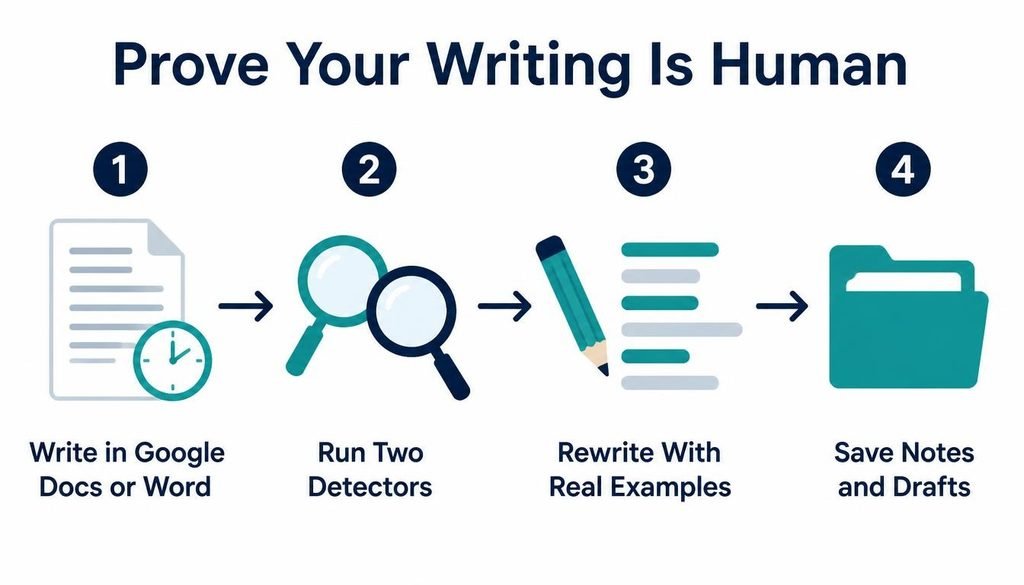
Follow these steps to build evidence of authorship and reduce the risk of a false flag:
- Step 1: Write and edit inside a cloud document with version history.
Draft in Google Docs or Word with AutoSave turned on. Timestamped version history shows your writing growing over time, which is far stronger evidence than any detector score. - Step 2: Run your draft through two independent detectors.
Use one strict tool such as Originality.ai and one balanced tool such as Winston AI or GPTZero. Compare where they agree. A passage flagged by both deserves attention. A passage flagged by only one is often noise. - Step 3: Rewrite flagged passive or repetitive sentences.
Replace generic claims with specific real-world examples, names, numbers, and details only you would know. Vary sentence length on purpose. Do not run the text through a humanizer, because that can create new problems and may breach your school or client rules. - Step 4: Save raw research notes and outline drafts as proof of authorship.
Keep brainstorming notes, source lists, outlines, and early drafts. If a score is ever challenged, these files show your process from idea to final text.
To confirm your wireless connection has enough stability to run real-time cloud editors without losing revision history, check how to test wifi signal strength.
If you work remotely using mobile tethering while checking drafts and want to avoid running out of bandwidth, read does hotspot use data.
Frequently Asked Questions
What is the best AI detector for teachers?
Winston AI is the strongest pick for teachers because it pairs AI scoring with OCR for scanned or handwritten pages and a classroom-focused report. Add GPTZero or Copyleaks as a second opinion, and never treat one score as proof of misconduct without a conversation with the student.
What is the best AI detector tool overall?
No single tool wins every scenario. Winston AI leads for academic essays, Originality.ai for SEO publishing and paraphrase detection, and Copyleaks for enterprise and multi-language needs. The best overall method is running two independent detectors and comparing results, since every detector is probabilistic.
What is the best AI detector according to Reddit?
Reddit users are anecdotal, but the common advice is to cross-check several tools. GPTZero is often the first stop because of its free tier, Originality.ai is described as the strictest, and many users warn that detectors disagree on the same text. Always check thread dates.
What is the best AI detector for Turnitin checks?
Turnitin is sold only to institutions, so students cannot run it directly. The closest public alternatives are Proofademic, Copyleaks, and Winston AI. None can predict an exact Turnitin score, so use them to find robotic passages, not to guess a percentage.
What is the best AI detector for essays and academic writing?
Winston AI is a strong choice for essays and academic writing, with Proofademic and Copyleaks as useful cross-checks. Test your draft in two tools, keep your version history in Google Docs or Word, and save outlines and notes as proof of authorship.
Are free AI detectors accurate enough to trust?
Free detectors work for a first pass, but not for high-stakes decisions. Short samples produce unstable scores, and free tools often have word caps. GPTZero and QuillBot are useful starting points. Confirm important results with a second, stronger scanner and human review.
Why do AI detectors flag human writing as AI?
Detectors flag text with low perplexity and low burstiness, meaning predictable words and even sentence rhythm. Grammarly edits, formulaic templates, and non-native English writing all produce this pattern. A Stanford study found a 61.3 percent average false positive rate on TOEFL essays across seven detectors.
Can AI detectors catch paraphrased or humanized text like Walter Writes?
Sometimes. Light-touch classifiers are often fooled because humanizers raise word-level unpredictability. Deep token analyzers such as Originality.ai and Turnitin look at syntactic patterns that survive rewriting, and both advertise paraphrase detection. Results change as humanizers update, so no tool offers a guaranteed catch rate.
Final Thoughts on Choosing the Best AI Detector
The best AI detector depends on who you are and what is at stake. Teachers and students get the most from Winston AI and Proofademic. Publishers and agencies should look at Originality.ai. Enterprises and multi-language teams should consider Copyleaks. For a free quick check, GPTZero and QuillBot are practical starting points.
Four essential verification habits:
- Treat scores as probability: Never rely on a single percentage as final proof of authorship.
- Cross-check with two engines: Pair a strict scanner like Originality.ai with a balanced scanner like Winston AI or GPTZero.
- Log timestamped edit history: Always draft inside Google Docs or Word with AutoSave enabled.
- Write with human specificity: Add concrete examples, personal data, and varied sentence lengths rather than using AI humanizers.
That combination protects honest writers far better than any single score.